25 Barcelona Hotels With a Past
A house by Domènech i Montaner, a stretch of the Roman wall, a tower shaped like a sail, and the building where Picasso took his first studio.
Barcelona kept its modernista houses and its Roman walls, and both now hold hotels. This list has a house Domènech i Montaner built, a length of the first-century city wall you can sleep beside, a tower shaped like a sail, and the building where Picasso took his first studio.
The list is grouped by character, not ranked. Each hotel’s name links to its own site, where the rate is current and you book direct.
The grand old ones
Hotel España · El Raval
The España opened as an inn in 1859, beside the Liceu opera house, and it is one of the oldest hotels still running in the city. Lluís Domènech i Montaner, who built the Palau de la Música, remodeled it in 1903, and his ground-floor dining rooms survive intact — one with underwater mermaid murals, another with an alabaster chimneypiece. Its restaurant is run under the Basque chef Martín Berasategui.
Hotel Casa Fuster · Gràcia
Domènech i Montaner built Casa Fuster between 1908 and 1911, commissioned by Mariano Fuster as a gift for his wife. It was said to be the most expensive house in the city, faced in white Carrara marble. An electricity company bought it in 1962 meaning to tear it down; a public outcry saved it, and it opened as a hotel in 2004.
El Palace Barcelona · Gran Via
El Palace opened in 1919 as the Ritz, built for César Ritz’s company, and kept that name until 2005. During the Civil War it was collectivized and run as a communal canteen, Gastronomic Hotel No. 1. Salvador Dalí was a regular, and a suite carries his name.
Majestic Hotel & Spa · Passeig de Gràcia
The Majestic opened on Passeig de Gràcia in 1918 and passed its hundredth year in 2018. The Catalan Soldevila-Casals family has owned and run it the whole time. It sits on the city’s great modernista boulevard, a short walk from Gaudí’s Casa Batlló and Casa Milà.
Monument Hotel · Passeig de Gràcia
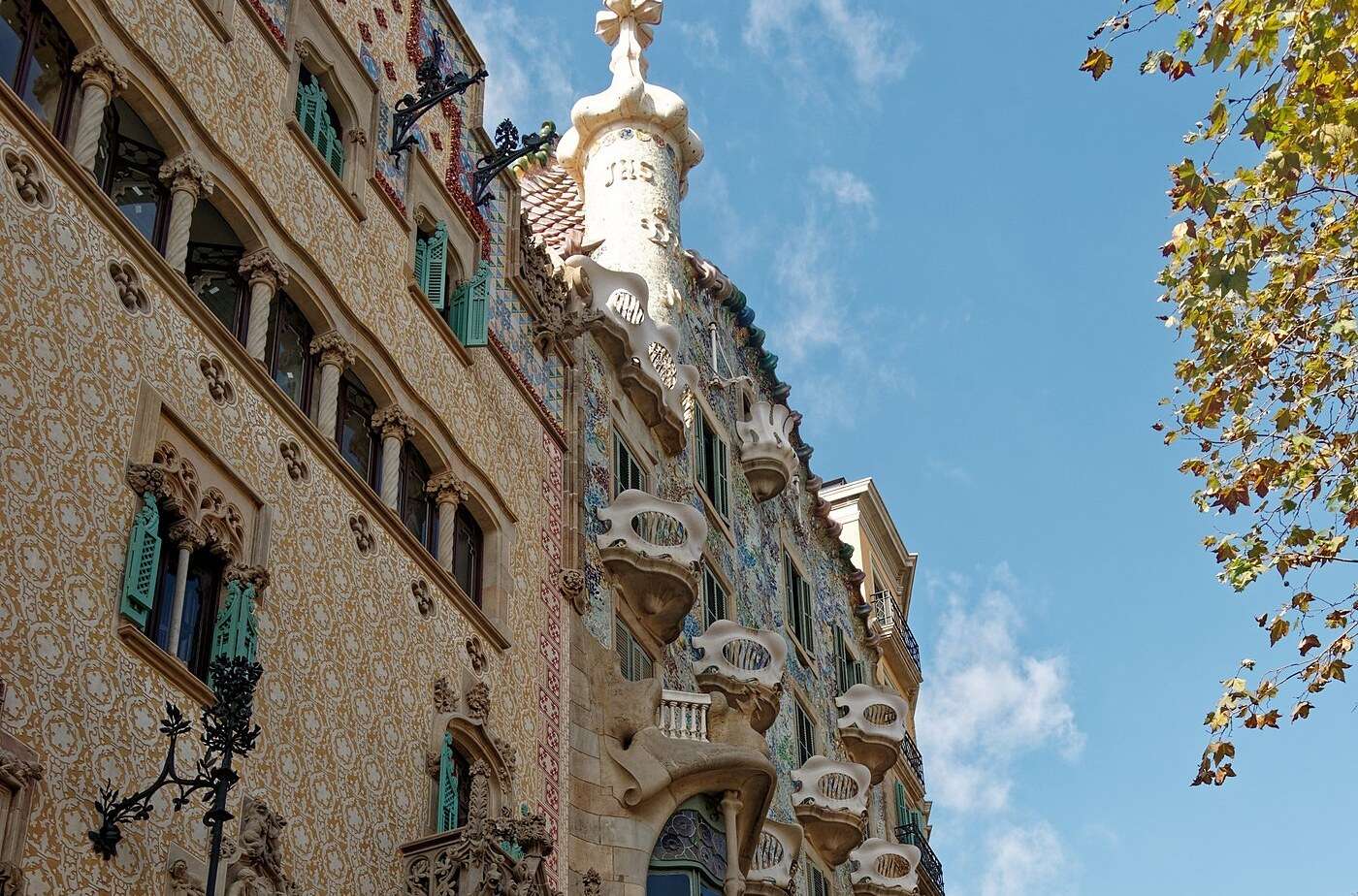
The Monument is in Casa Enric Batlló, a modernista building on Passeig de Gràcia finished in 1896. It reopened under this name in 2015. It holds Lasarte, Martín Berasategui’s restaurant and the first in Barcelona to win three Michelin stars.
Used to be something else
Hotel 1898 · La Rambla
The building was the headquarters of the Philippine tobacco company founded in 1881 by the Marquis of Comillas. The name marks 1898, the year Spain lost the Philippines and the firm had to remake itself. It opened as a hotel in 2005 behind the old facade, with a spa pool down in the former coal bunkers.
Grand Hotel Central · Via Laietana
The hotel is in Casa Cambó, built in 1926 on Via Laietana for the Catalan politician and financier Francesc Cambó, who put his own apartment and a library inside it. It reopened as the Grand Hotel Central in 2005. Its rooftop infinity pool is the draw.
Cotton House Hotel · Gran Via
The Cotton House is the former seat of Barcelona’s cotton makers’ guild, a neoclassical building on the Gran Via. It opened as a hotel in 2015.
Hotel Claris · Dreta de l’Eixample
The Claris sits behind the preserved facade of the 19th-century Vedruna Palace. Its owner, a collector, fills it with antiquities — Roman, Egyptian, and pre-Columbian pieces — on show through the hotel.
Nobu Hotel Barcelona · Sants
The Nobu took over the tower that was the Gran Hotel Torre Catalunya, beside Sants station. Nobu Hospitality was co-founded by the chef Nobu Matsuhisa with Robert De Niro and the producer Meir Teper. It opened around 2019, with the restaurant up on the top floor.
The Serras · Port Vell
The building is said to have held Picasso’s first studio, taken by the teenage artist around 1896. It opened as The Serras in 2015, facing the Port Vell marina.
Hotel Duquesa de Cardona · Port Vell
The Duquesa de Cardona is a restored 16th-century noble palace facing the old port. It opened as a hotel in 2003, with the stone facade kept intact.
Alma Barcelona · Dreta de l’Eixample
Alma is in an 1872 Eixample building from the years of Cerdà’s grid plan. It reopened as a hotel in 2011, built around a hidden interior garden.
Old-town stones
Hotel Neri · Gothic Quarter
The Neri is a medieval palace on Plaça de Sant Felip Neri, a hidden square in the Gothic Quarter. The church across the square still carries the shrapnel scars of a 1938 bombing that killed children sheltering there. The hotel opened in 2003.
Mercer Hotel Barcelona · Gothic Quarter
The Mercer is built into a surviving stretch of Barcelona’s Roman wall, and sections of the old fortification stand inside the hotel. The restoration was led by the Pritzker Prize architect Rafael Moneo.
Soho House Barcelona · Gothic Quarter
Soho House is in a 19th-century building on a quiet square near the waterfront. It opened as the group’s Barcelona club and hotel in 2016.
Buildings that stop you
W Barcelona · Barceloneta
The W is a glass tower shaped like a sail, standing out on the Barceloneta breakwater. Ricardo Bofill designed it, and it opened in 2009. Everyone in the city calls it the Hotel Vela — the sail.
Hotel Arts Barcelona · Port Olímpic
The Arts is a 44-floor steel tower built for the 1992 Olympics in the Port Olímpic, and opened in 1994. It is still one of the tallest buildings in Spain. Frank Gehry’s giant copper fish stands at its base, on the waterfront.
Ohla Barcelona · Via Laietana
The Ohla’s 1920s facade is studded with ceramic eyeballs, an installation by the artist Frederic Amat. Inside is Caelis, a Michelin-starred restaurant.
Small and singular
The Wittmore · Gothic Quarter
The Wittmore is an adults-only hideaway on a Gothic Quarter side street, with no sign outside. It holds around two dozen rooms.
Hotel Praktik Bakery · Dreta de l’Eixample
A working branch of the Baluard bakery operates right in the lobby, so the whole entrance smells of fresh bread. It is one of the city’s independent Praktik hotels.
Margot House · Passeig de Gràcia
Margot House is a nine-room hideaway on Passeig de Gràcia, directly across from Gaudí’s Casa Batlló. It was made as a quiet, apartment-like retreat above the shops.
Casa Camper · El Raval
Casa Camper is the hotel side of the Mallorcan shoe company, in a restored 19th-century building in the Raval. It opened in 2005, and keeps a free snack-and-drinks pantry open around the clock for guests.
Hotel Brummell · Poble-sec
The Brummell is a design hotel in Poble-sec, a working neighborhood below Montjuïc, in a converted early-20th-century building. It opened in 2015, named for the Regency dandy Beau Brummell.
H10 Casa Mimosa · Dreta de l’Eixample
Casa Mimosa is a late-19th-century Eixample building that backs onto the garden block behind Gaudí’s La Pedrera. The H10 group restored it and opened it in 2017.
Frequently Asked Questions
Are these hotels ranked?
No. The groups sort them by character, and the order within each group carries no meaning.
What made a hotel interesting enough for this list?
A story. Every entry was a modernista house, a bank or guild hall, a palace, a Roman wall, or an architect’s landmark. Comfort alone did not qualify a hotel.
Why are there no prices?
Rates change daily and a priced list goes stale in a month. Every hotel name links to its own site, where the rate is current and you book direct.
Which hotel puts me closest to the day trips on this site?
Most day trips from Barcelona leave by train from Sants or the Passeig de Gràcia station. The Eixample hotels sit closest to Passeig de Gràcia; the Nobu is next to Sants.
Do the small hotels book out faster than the grand ones?
Usually. The smallest — the nine-room Margot House, the Wittmore — hold only a handful of rooms and fill first. Book those well ahead.